
Bangkok creator CPM benchmarks for SMBs in 2026
By Mai Influence
If you are running a Bangkok creator campaign in 2026 and you cannot quote a cost-per-1,000-views figure back to your finance lead, you are flying blind. Flat fees hide the real story. A 25,000 THB Reel that pulls 40,000 views and a 25,000 THB Reel that pulls 180,000 views are not the same purchase, and treating them that way is how SMB marketing budgets quietly burn. This post is the CPM cheat sheet we wish someone had handed us the first time we booked a creator in Sukhumvit.
The numbers below come from Mai Influence roster campaigns run between Jan and Oct 2026, cross-checked against rate cards we see submitted weekly. They are typical mid-market ranges for SEA brands spending between 50,000 and 500,000 THB per campaign. They are not Unilever benchmarks. If you are spending above 2M THB per campaign, agency rate decks will skew higher and you should use those instead.
What a Bangkok creator CPM actually measures
Creator CPM in Bangkok is the flat fee divided by paid-view performance across the first 30 days, times 1,000. Not organic lifetime. Not "estimated reach". Views the platform counted, in the first month, on the post you paid for. This window matters because the long tail on Thai TikTok and Instagram is noisier than the first-30 curve, and finance teams need a number they can actually reconcile against invoices.
Two things to pin down before you benchmark:
- Which platform you are measuring. Reels, TikTok, Shorts, and LINE VOOM do not share a CPM reality. See our platform rate multipliers post for the raw fee side of this.
- Whether you are counting usage rights. A post you can repurpose into paid ads is worth more per view than a one-and-done. If your fee includes six-month whitelisting, your CPM should be adjusted down by roughly 20 to 30 percent to reflect the extra inventory you now own.
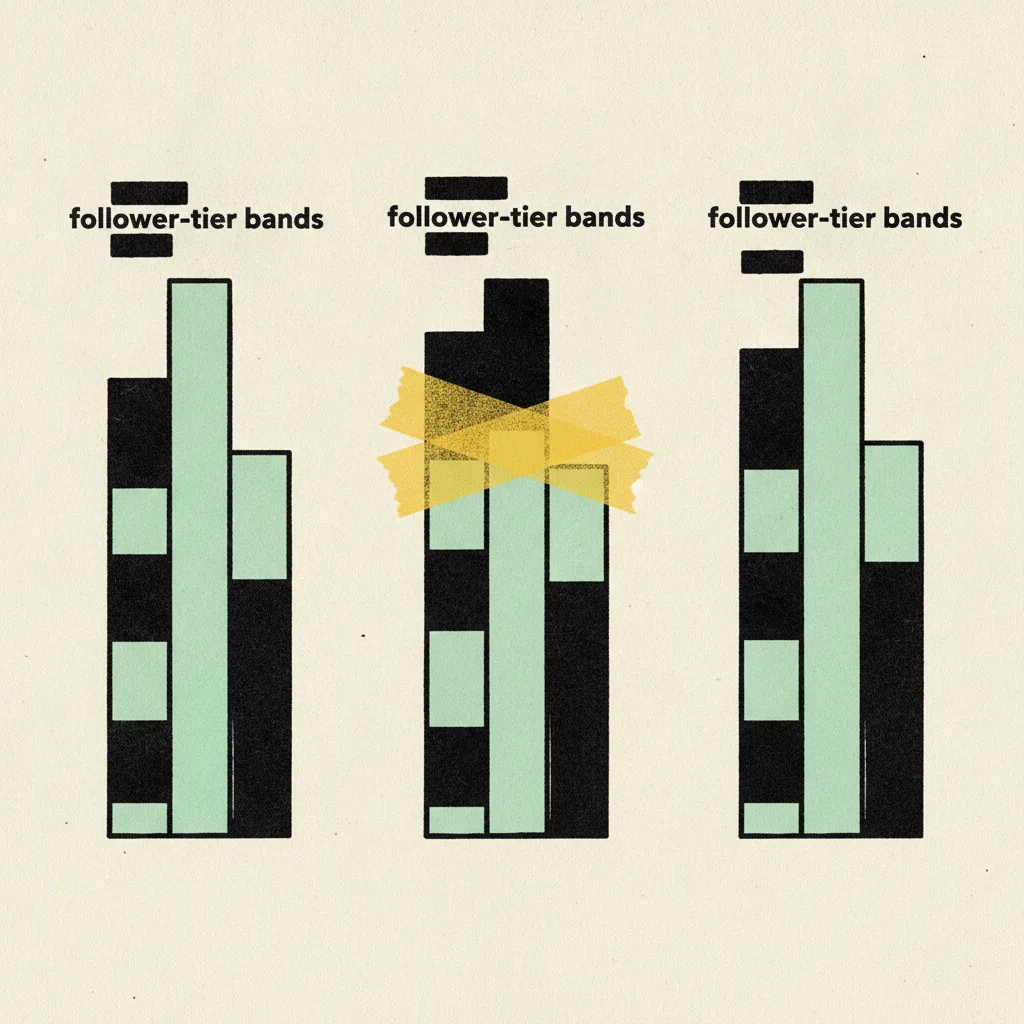
The 2026 ranges by tier, in THB
Here is the working set. Typical is the middle of our observed range. Top quartile is what good-performing creators pull. If you are paying above top-quartile CPM without a specific reason (a sold-out product tie-in, a regulated vertical, a bilingual deliverable), something is off.
Nano creators (5K to 20K followers)
- Instagram Reel: typical 320 THB, top-quartile 180 THB.
- TikTok post: typical 220 THB, top-quartile 120 THB.
- Instagram Story set (3 frames): typical 480 THB, top-quartile 280 THB.
Micro creators (20K to 100K followers)
- Instagram Reel: typical 280 THB, top-quartile 170 THB.
- TikTok post: typical 180 THB, top-quartile 95 THB.
- YouTube Shorts: typical 240 THB, top-quartile 140 THB.
Macro creators (100K+ followers)
- Instagram Reel: typical 210 THB, top-quartile 130 THB.
- TikTok post: typical 140 THB, top-quartile 80 THB.
- YouTube long-form segment: typical 650 THB, top-quartile 380 THB.
The pattern most SMB marketers miss: micro beats macro on CPM in Bangkok roughly four times out of five, and nano beats micro on niche categories (skincare, hyper-local F&B, fitness). The counter-case for macro is reach you cannot stitch together from a nano portfolio in one week. If you need 500,000 views in 7 days against a product launch, macro is still the clean answer. Our creator mix guide lays out when to weight each tier.
Where Bangkok creator CPM breaks
Benchmarks are a floor, not a verdict. Three situations should move your acceptable CPM up or down before you sign.
Platform skew by category. Beauty and skincare run roughly 15 percent cheaper on TikTok than on Reels in Bangkok because supply is deep. F&B runs about the same on both. Fitness, wellness, and anything requiring Thai-language explainer context runs 25 percent more expensive on Reels because production value matters more to the audience. Bangkok clinic skincare rates break this down for one specific vertical.
Format skew. Carousels on Instagram return lower views per Baht spent but higher save-rate, which matters if you are measuring consideration rather than reach. A carousel at 280 THB CPM looks expensive next to a Reel at 180 THB until you compare save-to-purchase conversion on a retargeting audience. Pick the metric that matches the funnel stage, then benchmark against the format that fits it.
Bilingual delivery. A Thai-English creator post, where the creator delivers the same hook twice and pins both captions, runs about 1.3x the single-language rate. The CPM usually ends up roughly on par because the second language unlocks a wider audience, but if the post targets Thai-only neighbourhoods (Thonburi, Nonthaburi), you are paying for inventory you do not need. See our bilingual deliverables post for when it earns its keep.
The quiet CPM killers in a Bangkok campaign
Three line items quietly push your real CPM above the rate-card number. Catch them in the brief, not in the post-mortem.
A Bangkok creator campaign that looks like 180 THB CPM on paper usually clears at 230 to 260 THB once you add kill-fee buffers, revision bloat, and usage-rights extensions.
Revision-round creep. Every unlimited-revisions clause is a hidden 15 to 25 percent CPM tax, because the effective fee goes up while views stay flat. Cap revisions at two rounds in the contract and pay for extras at a fixed add-on. We dig into the language in our revision cap post.
Usage-rights extensions. A six-month whitelist you actually use is an asset. A six-month whitelist you forget to activate is 20 percent of your fee set on fire. Only buy the rights window you have a documented plan to run paid against. If you are not sure, start at 30 days and extend if the post performs.
Approval-chain drag. Each extra stakeholder on sign-off adds roughly 2 to 4 days to the production timeline, and delay compresses the publishing window, which compresses first-30-day views, which inflates CPM. Our approval-chain post covers how to keep the chain to three people.
How to use these numbers this week
Pull your last three creator invoices. Match each to first-30-day views the platform actually reported, not the pitch-deck estimates. Divide, multiply by 1,000, and compare the result to the tier and platform rows above. If you land inside typical, you are competitive. If you land above top-quartile, you have a renegotiation on your hands. If you land below top-quartile, hold the relationship and re-book, because that creator is undervalued and the market will catch up fast. Brands that run this exercise quarterly stop leaking budget on the same two or three recurring overpayments.
When you are ready to bake these benchmarks into a brief, book a brand call and we will walk through the specific tier mix for your category. CPM is boring until it is the number that saves your Q1 budget.