PromptPay vs bank transfer for Bangkok creators 2026
By Mai Influence
Every Bangkok creator invoice ends the same way. A line at the bottom that reads "PromptPay to 08X-XXX-XXXX" or a bank account number at Kasikorn, SCB, or Bangkok Bank. Most SMB marketers in Thailand pick whichever one the creator sent last and never think about it again. That is fine at one or two invoices a month. It becomes an accounting problem the day you scale to eight or ten.
PromptPay and bank transfer are not interchangeable. They clear at different speeds, leave different audit trails, and have different consequences at tax time. In 2026, with the Revenue Department's e-Tax Invoice push and the 3% withholding rule for services still in force, the rail you pick decides whether your finance person spends 20 minutes or two hours per campaign reconciling. This piece is the short version of what we tell brands onboarding to the platform.
What PromptPay actually is
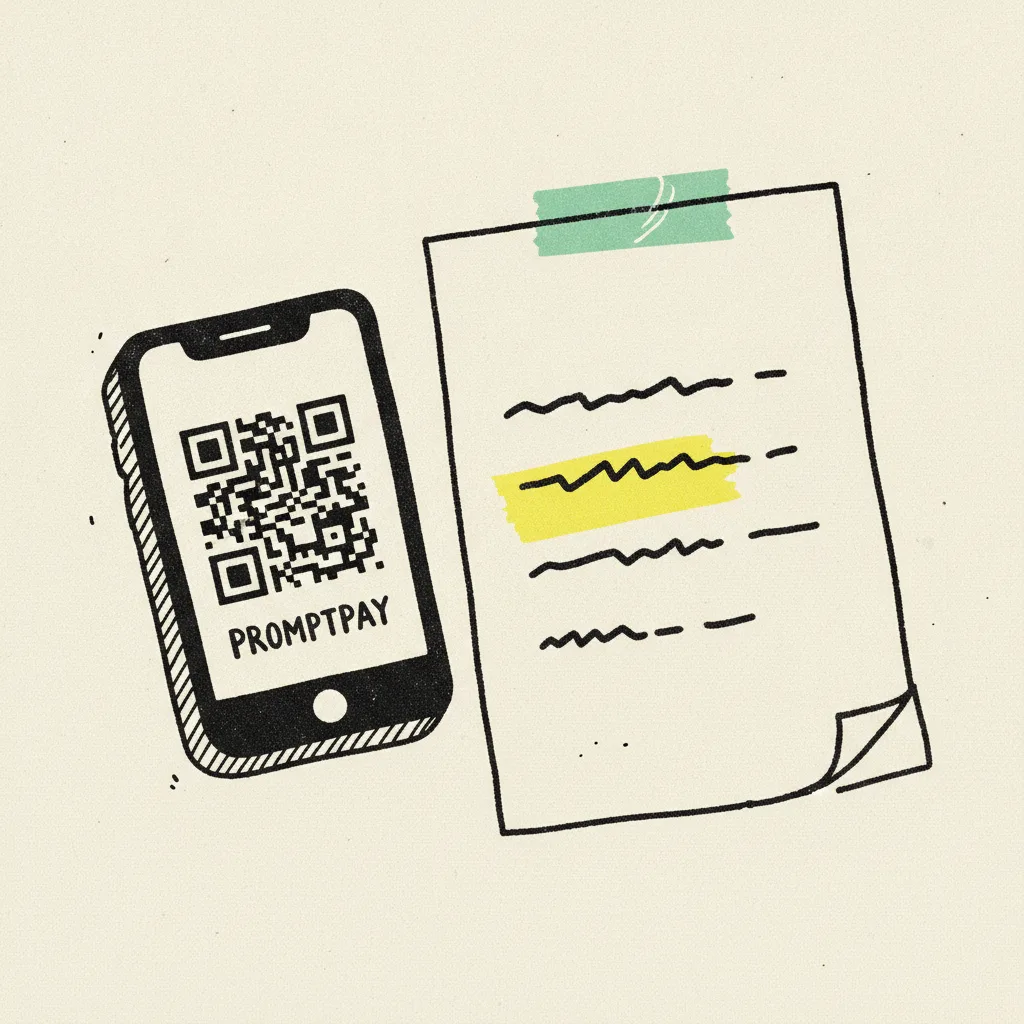
PromptPay is Thailand's real-time interbank rail, built on top of the National ITMX switch. You send money to a phone number, a Thai ID number, or a QR code. It settles in under 15 seconds, 24/7, including Sundays and Songkran. Under 5,000 THB per transfer, there is no fee. Between 5,000 and 30,000 THB, the fee is 2 THB. Above 30,000 THB, 5 THB. Above 100,000 THB, 10 THB. For a 40,000 THB Reel-plus-carousel package, you are paying 5 THB to move the money. That is the entire cost of the rail.
The catch is that PromptPay slips are photos, not receipts. Your bank app produces a JPEG or PDF with a reference number, an amount, and the destination phone number. It does not name the recipient's registered business, and it does not itemise VAT. For a single 8,000 THB nano-creator payment, no one cares. For a 60,000 THB campaign paid across three tranches, your bookkeeper will care.
What bank transfer gives you that PromptPay does not
A direct bank transfer, especially between two business accounts, produces a bank-issued statement line that includes the sender name, the receiver name, the reference field, and the timestamp. Your bank downloads that as a CSV or MT940 file every month. Xero, QuickBooks, and FlowAccount all import it in one click. Reconciliation is automatic if the reference field matches your invoice number.
Bank transfer is also the only rail that plays cleanly with the 3% withholding tax on services. When you pay a Thai creator who is not VAT-registered, you are legally required to withhold 3% and remit it to the Revenue Department with a Por Ngor Dor 3 form. The receipt you issue back to the creator has to reference the actual payment. Doing that off a PromptPay screenshot is a manual data-entry exercise. Doing it off a bank statement line is a filter and a paste.
The cost, though, is friction. A same-bank transfer clears in minutes and costs nothing. A cross-bank transfer under 2,000,000 THB clears same-day on ORFT for 25 to 35 THB. BAHTNET, the wholesale rail used for high-value corporate transfers, clears in real time but costs 150 THB minimum and requires branch-level setup. None of these are punishing on a per-transfer basis. They add up if you are running 30 creator payments a month and paying 30 THB a pop.
When to use which
The heuristic we give brands during onboarding is boring, which is why it works.
- PromptPay for anything under 20,000 THB paid to an individual creator, when a proper invoice PDF has already been sent, and when you do not need to withhold tax (either the creator has issued a WHT waiver form or the amount is below the 1,000 THB service floor).
- Bank transfer for anything above 20,000 THB, any payment to a registered
ห้างหุ้นส่วนorบริษัท(partnership or company), any payment where you are withholding 3%, and any payment that will be audited (agency clients, listed brands, government campaigns). - Stripe or escrow for cross-border payments where the creator is invoicing in USD, or when the brand needs proof-of-delivery before funds release. This is the specific slot our escrow rail was built for.
If you are running most of your work through a marketplace, the platform picks the rail for you. What you are actually choosing between is whether to run creator payments in-house at all. Our in-house vs marketplace piece walks through the maths on that decision at different volumes.
A 40,000 THB campaign paid over PromptPay clears in 15 seconds and costs 5 THB. The same campaign paid by cross-bank transfer clears same-day and costs 30 THB. The 25 THB difference is not the point. The 20 minutes your bookkeeper saves each month is.
The withholding tax trap
This is where most first-time brand marketers get burnt, and it has nothing to do with PromptPay itself. In Thailand, if you are a juristic person (a registered company or partnership) and you pay a service provider more than 1,000 THB in a tax year, you are required to withhold 3% on that payment. That includes creators. It includes them whether you paid by PromptPay, by cash, or by BAHTNET.
If you skip the withholding, the Revenue Department can assess the missing tax against you, not the creator, plus a surcharge. If you did it correctly but paid by PromptPay with no invoice PDF and no WHT certificate, you are technically compliant but you have no defensible paper trail if audited. The rail did not cause the problem. The lack of paperwork did.
Our payment terms guide covers the invoice-and-WHT flow end to end. For this piece, the short version is: whatever rail you pick, the invoice comes first, the WHT certificate comes with the payment, and the bank slip or PromptPay screenshot goes on top of both.

What we actually see brands do
The brands that scale past ten creator payments a month split their flow. PromptPay for retainers under 20,000 THB and one-off nano bookings. Bank transfer for anything with a company invoice or a WHT filing. Stripe or platform escrow for anything cross-border or high-risk. Nobody uses a single rail for everything, and the ones who try burn a Friday afternoon every month cleaning up the mismatch.
One F&B brand we onboarded in Q2 2026 was paying 14 creators a month, all via PromptPay, all through a single founder's personal phone. Their bookkeeper reconstructed the trail from screenshots at year-end. It took three days. The following quarter they moved everything above 15,000 THB to bank transfer, kept PromptPay for the small stuff, and cut the reconcile job to half a day. The rail did not change the total spend. It changed the total time. That is usually the trade you are making.
Set the split, write it into your brief template, and stop deciding case by case. Your finance team will notice.