Live-commerce rates for Bangkok creators in 2026
By Mai Influence
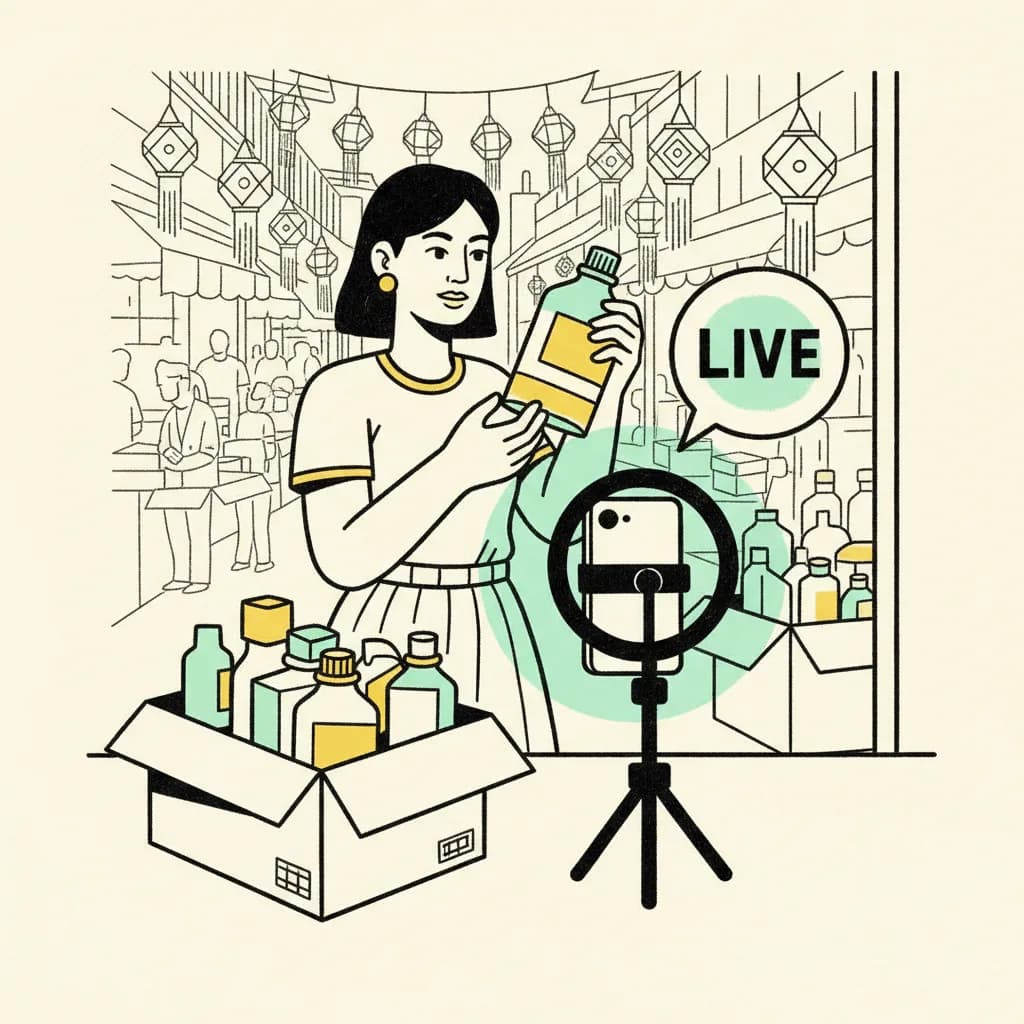
Live-commerce is not a Reel with better lighting. You are selling for two to four hours, reading comments, remembering SKUs, hyping prices, and keeping energy up while someone backstage swaps products. If a brand is paying you the same as a single Instagram post, you are being underpaid by a factor of three to five.
Here is what the Bangkok market is actually paying in 2026, by tier, with the top-quartile numbers you can reach if your sell-through is good.
The hourly floor nobody tells you
Flat hourly fees are the honest baseline, and you should always quote one even if commission is on the table. The hourly covers your time, your setup, and the risk that the stream flops through no fault of yours.
Typical Bangkok ranges in 2026 for a two to three hour session on TikTok Shop, Shopee Live, or Lazada Live:
- Nano (5K to 20K): typical THB 2,500 to 4,000 per hour, top-quartile THB 6,000.
- Micro (20K to 100K): typical THB 5,000 to 9,000 per hour, top-quartile THB 15,000.
- Macro (100K+): typical THB 12,000 to 25,000 per hour, top-quartile THB 45,000.
If the brand insists on commission-only, your hourly floor becomes a minimum guarantee instead. Never agree to pure commission unless you have run three sessions with that exact brand and you know the conversion.

Commission splits that actually make sense
The second number is commission on sales during the stream, plus a short attribution window after. Standard in Bangkok sits at 10 to 15 percent of gross merchandise value for mid-ticket beauty and fashion. Food and FMCG runs lower, 5 to 8 percent, because the margins are thinner. Electronics and small appliances hover around 6 to 10 percent.
Attribution window matters more than the headline percentage. A 15 percent commission on a 15-minute window after the stream is often worth less than 10 percent across 24 hours. Push for a 24 hour window at minimum. Top creators in Bangkok are getting 48 hours.
Watch the deduction clauses. Returns, cancelled orders, and platform fees should be deducted from GMV before your cut only if that is spelled out in writing. If the contract is silent, assume gross. If the brand later tries to deduct, you have your contract.
If a brand will not commit to a 24 hour attribution window and a written definition of commissionable GMV, walk. Every seasoned Bangkok live-seller has lost money chasing a vague split.
Setup fees you should be charging separately
Live-commerce has real production costs that creators eat silently. Stop eating them. Price them as line items on the quote. Your free creator profile on Mai Influence has a quote builder that lets you add these as separate rows so the brand sees the real cost of a stream, not just your time.
The common ones in Bangkok:
- Studio or location rental if the brand wants a specific look, THB 1,500 to 5,000 for the session.
- A second-camera operator or product handler, THB 1,500 to 3,000 for the stream.
- Script and SKU preparation, 2 to 4 hours of your time at your hourly rate.
- Platform-specific effects, overlays, or stickers if the brand asks for custom branding, THB 1,000 to 3,000.
- Repeat-stream commitment discount, which only applies if the brand books three or more streams up front.
Charging these as line items has a second benefit. When a brand compares your quote with another creator's single all-in number, yours looks like a real producer, not a hobbyist.
Platform differences that change your price
TikTok Shop is the biggest live-commerce platform in Thailand right now and the one where commission-plus-hourly makes the most sense. Shopee Live and Lazada Live are more frequently hourly-only or hourly-plus-small-bonus, because the shoppers browse mid-stream rather than panic-buy on the live.
- TikTok Shop: hourly plus 10 to 15 percent commission is the norm. Streams run 2 to 4 hours. Peak slots are 7pm to 10pm Bangkok time.
- Shopee Live: hourly plus optional bonus tiers (hit THB 50K GMV, get THB 2,000 bonus). Streams run 1 to 3 hours. Peak is 8pm to 11pm.
- Lazada Live: mostly hourly, occasionally commission for electronics. Streams run 1 to 2 hours. Lower average GMV but easier bookings for nano creators.
- Facebook Live: still alive in Thailand for older demographics and food, usually hourly only, THB 2,000 to 6,000 for the session depending on reach.
If the brand asks you to go live on two platforms simultaneously, that is a second deliverable. Charge 60 to 75 percent of your base hourly rate on top, not 100 percent, because the setup is shared but your attention is split.
What a clean live-commerce quote looks like
Keep the quote scannable. A brand's procurement team should be able to read it in 30 seconds. One session, one page.
Include your hourly rate with session length, your commission percentage and attribution window, each production line item, the platforms included, the territories and languages, and the payment terms. Payment terms should be hourly fee within 30 days of the stream, commission within 15 days of the attribution window closing.
If a brand pushes back on hourly plus commission and asks for a flat all-in, that is fine, but your flat number should land at your hourly fee times 1.4. The 40 percent uplift covers the commission you are giving up and the risk you are absorbing. Never agree to a flat all-in that is below your pure hourly rate.
Live-commerce is one of the few places where Bangkok creators can earn 100,000 baht in a weekend if the stack is right. Price it like the production job it is and the money shows up. Price it like a reel and you leave half of it on the table.